Badminton Calves: Why the Lunge Is Your Achilles Risk
Quick Answer: The badminton net lunge loads the calf and Achilles eccentrically at high speed, sometimes several times body weight, and it happens hundreds of times per session. Most calf and Achilles injuries in badminton are cumulative rather than accidental. The protection is heel raise strength - both straight-leg and bent-knee - plus a proper warm-up, honest session frequency, and paying attention to morning stiffness.
Everyone worries about their knees and their shoulder. The tissue that actually gets injured most often in badminton is lower down, and the movement responsible is the one you do more than any other.

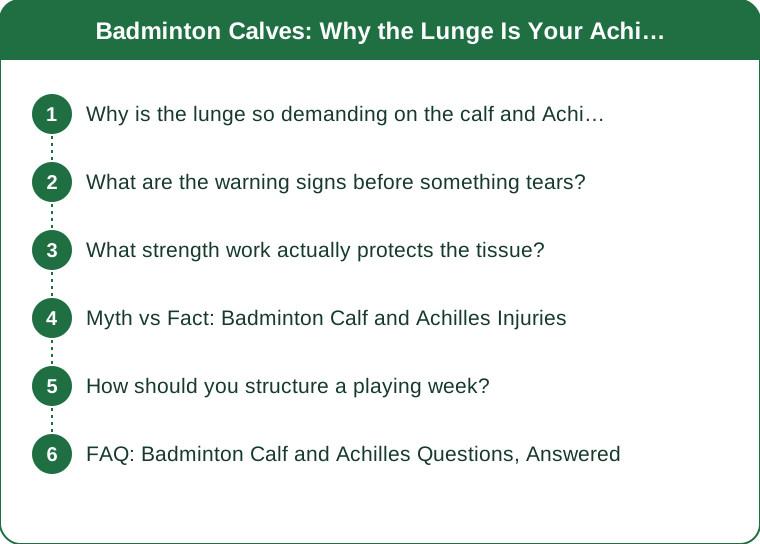
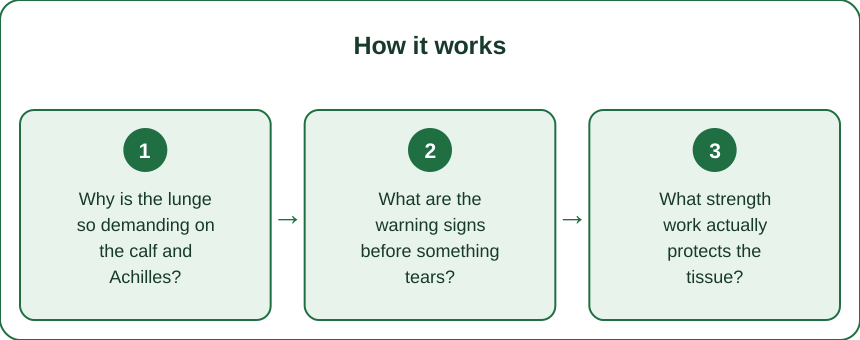
Why is the lunge so demanding on the calf and Achilles?
Because it asks the calf complex to absorb a fast, high, eccentric load - lengthening under tension - and then immediately produce force to push you back out.
Break down a net lunge:
The landing. Your lead foot lands ahead of your body with your body weight moving forward and downward. The calf muscles and Achilles tendon decelerate that, lengthening under load. Studies of lunging in racket sports have found ground reaction forces around two to three times body weight, arriving in a fraction of a second.
The hold. At the bottom, the ankle is in a deep dorsiflexed position with the knee well over the foot - a long-tendon, high-tension position.
The push-out. You then have to reverse direction and return to base, which requires rapid concentric force from the same tissue.
Then the repetition count. A competitive singles player performs a very large number of lunges and direction changes per match. Even a social doubles session involves hundreds of loaded ankle movements.
Why this produces injuries:
- Eccentric loading at speed is the highest-strain condition for a tendon
- Cumulative repetition means the tissue rarely gets a full recovery window in a busy playing week
- Cold starts are common in club play, where court time is limited and people go straight into rallies
- The demand is asymmetric - most players lunge on their racket-side leg far more, which is why symptoms are usually one-sided
The Achilles is the strongest tendon in the body and it still fails under this pattern, mostly because the pattern is repeated without the strength base to support it.
What are the warning signs before something tears?
Achilles problems almost always announce themselves. The mid-match rupture that seems to come from nowhere is usually preceded by weeks of ignored signals.
Early signs, in the order they typically appear:
- Morning stiffness in the Achilles or calf that eases after a few minutes of walking - this is the classic first sign and the most ignored
- Aching after play that was not there before, settling within a day
- Stiffness at the start of a session that warms up and disappears
- Localised tenderness when you pinch the tendon a few centimetres above the heel
- A slight thickening of the tendon compared with the other side
The pattern that means back off now:
- Morning stiffness getting worse week to week
- Pain that no longer warms up, or that returns during the session
- Pain on single-leg heel raises or on stairs
- Any swelling around the tendon
Signs that need urgent medical attention: a sudden sharp pain with a snapping or popping sensation, an inability to push off or stand on tiptoe, or a visible gap in the tendon. An Achilles rupture is a medical emergency and needs same-day assessment.
The rule worth writing down: morning stiffness that increases across two consecutive weeks means reduce your playing load and start loaded calf work now, not after it hurts during play. This is general information, not medical advice - persistent tendon pain deserves a proper assessment.
What strength work actually protects the tissue?
Calf strength is the protection, and it needs to cover both parts of the muscle group and both speeds.
The base - do this twice a week, all year:
Straight-leg heel raises. Standing, knee straight, rise onto the ball of the foot and lower slowly over 3 seconds. This targets the gastrocnemius, which crosses the knee. Progress to single leg, then add weight. Target 3 sets of 12 to 15 single-leg reps with control before considering yourself covered.
Bent-knee heel raises. Seated with knees bent around 90 degrees, or standing with a soft knee. This targets the soleus, which is the muscle most active in the deep lunge position and the one most commonly under-trained. 3 sets of 15 to 20. Do not skip these - the soleus takes a large share of the load in the position badminton puts you in.
Then add speed and elasticity, once the base is there:
Pogo hops. Small fast bounces on the balls of the feet, minimal knee bend. 3 sets of 20. Trains the tendon’s spring quality.
Split-stance drop and hold. Step into a lunge position and absorb the landing, holding the bottom for 2 seconds. 8 each side. This is the closest gym movement to what a net lunge actually asks.
Loaded deep lunge holds. Hold a lunge with the front ankle in a deep position for 20 to 30 seconds, building tolerance in the exact range where the tendon is most loaded.
Progression rule: build the slow strength work for six to eight weeks before adding the hopping work. Adding elastic and speed work to an under-strengthened tendon is how people generate the injury they were trying to prevent.
Myth vs Fact: Badminton Calf and Achilles Injuries
Myth: Stretching before you play prevents calf injuries. Fact: Static stretching before explosive activity has not been shown to prevent injury and may temporarily reduce force production. A progressive warm-up with movement - jogging, skipping, gradually deeper lunges, some hops - is what the evidence supports.
Myth: Achilles ruptures happen without warning. Fact: A minority genuinely do, but most people describe weeks or months of stiffness and aching beforehand. The warning almost always exists; it is just not painful enough to change behaviour.
Myth: If it warms up during play, it is fine. Fact: Warming up is what irritated tendons do. It is a characteristic feature of tendinopathy, not evidence of health, and it is the reason people play on a deteriorating tendon for months.
Myth: Better shoes will prevent it. Fact: Proper court shoes matter - they provide lateral support and grip that running shoes do not, and worn-out midsoles increase load. But no shoe substitutes for calf strength, and shoe changes will not fix an under-strengthened tendon.
Myth: You should rest completely if your Achilles hurts. Fact: Current guidance for tendinopathy favours progressive loading over complete rest. Reduce the aggravating activity and start controlled heel raise work - rest alone tends to leave the tendon less tolerant when you return to court.
How should you structure a playing week?
The load management piece is where most club players go wrong, usually by accident.
Warm-up properly, every session - 10 to 12 minutes. Not knocking up for two minutes.
- 3 minutes easy movement - jogging, side steps, on-court shadow movement
- 2 minutes dynamic work - leg swings, ankle circles, walking lunges
- 3 minutes progressive intensity - shadow lunges getting gradually deeper and faster
- 2 minutes hops and short sharp movements, so the tendon has already experienced speed before the first rally
- Then knock up, which is practice and not a warm-up
Playing frequency. Two or three sessions a week with a day between is manageable for most club players. Playing four or five consecutive days without a break is the pattern most associated with cumulative tendon problems.
Watch the hidden spikes. A tournament weekend, a new league season, or a coaching block that suddenly triples your court time in one week is a classic trigger. Increase court time by roughly 10 to 20 percent a week, not by doubling it.
Check your shoes. Court shoes lose midsole cushioning and lateral support long before the uppers look worn. Press your thumb into the midsole - if it stays dented, replace them. Never use running shoes on court; they lack lateral stability and are a separate injury risk.
And put the calf work in the same week, not as an extra. Two sessions of heel raises, ten minutes each, on non-consecutive days. It is the cheapest insurance available for the movement you will do several hundred more times this month.
FAQ: Badminton Calf and Achilles Questions, Answered
Why is it always my racket-side leg?
Because you lunge on it far more often - the forward lunge to the net is almost always led by the racket-side leg. Train the weaker side with an extra set and expect a genuine asymmetry rather than treating it as a problem.
Can I keep playing with Achilles stiffness?
Often yes, with modification - reduce session frequency, cut the volume of deep lunging, warm up more thoroughly, and start heel raise work. If it hurts during play, is worse week to week, or you cannot do a single-leg heel raise comfortably, get it assessed before continuing.
Do compression sleeves help?
Some players find they help with comfort and warmth, and there is limited evidence for a small effect on soreness. They do not reduce tendon load and should not be used to play through pain.
How long does Achilles tendinopathy take to settle?
With consistent loaded calf work, many people improve noticeably in 6 to 12 weeks. Tendon remodelling is slow, so timelines in weeks and months are normal - and stopping the strength work once it feels better is the most common reason it comes back.
TL;DR:
- The net lunge loads the calf and Achilles eccentrically at two to three times body weight, hundreds of times a session
- Most badminton Achilles injuries are cumulative, and morning stiffness is the first warning sign
- Train both straight-leg and bent-knee heel raises - the soleus is the commonly missed one
- Build slow strength for six to eight weeks before adding hops and drop-and-hold work
- Warm up for 10 to 12 minutes including hops, and keep court-time increases to 10 to 20 percent a week
- Replace court shoes on midsole feel, and never play in running shoes
Badminton asks your calves to absorb a hard landing in a deep position several hundred times an evening. Almost nobody trains for that specifically, which is why the injury is common and why twenty minutes a week of heel raises is the highest-value thing in this whole sport.
Keep Reading
This article is for general informational and styling purposes only. Fit, sizing, and product availability may vary.