Doubles Diplomacy: Badminton Etiquette Nobody Explains
Quick Answer: Social badminton doubles runs on a handful of unwritten rules — call the shuttle when it’s headed down the middle, announce the score before every serve, rotate off the court after a few wins instead of camping on it, and apologize (briefly, cheerfully) if you hit your partner. None of it is in the official rulebook, but skip it and you’ll notice fast.
Nobody hands you a manual on your first night of open-play doubles. You just show up, and within ten minutes you’ve witnessed a shuttle-ownership standoff, a forgotten score, and two players silently daring each other to move for a ball drifting down the middle.

Who takes the shuttle when it’s heading down the middle?
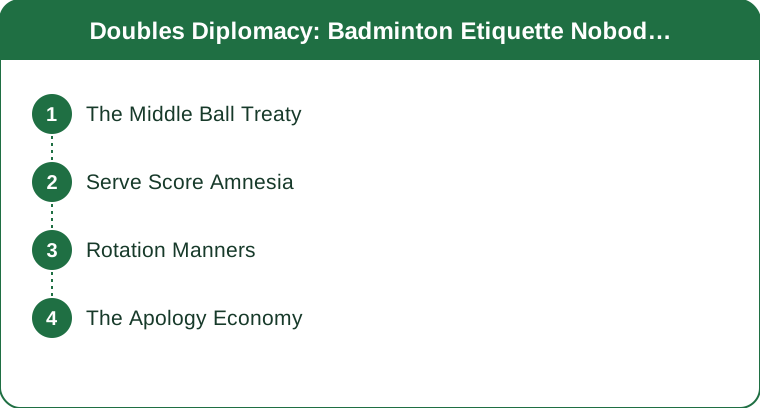
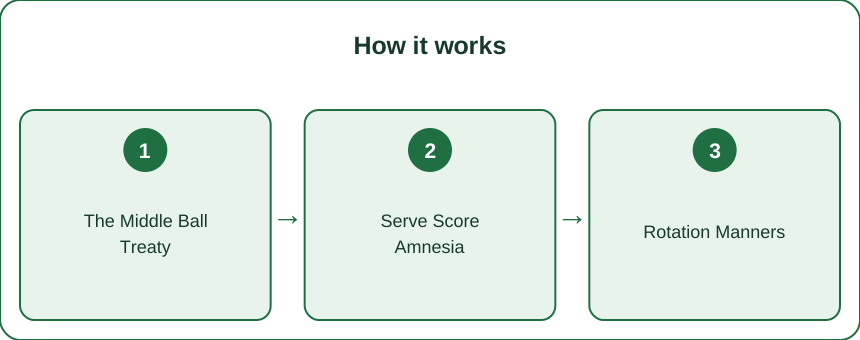
This is the single most common doubles standoff, and the fix is simple: the player on the forehand side takes it, or whoever calls “mine” first, whichever comes first. Waiting politely for the other person to move is how a shuttle lands untouched right between two players who both could’ve reached it.
Calling the shot early — even a half-second early — matters more than perfect positioning. A loud, quick “mine” or “yours” prevents almost every middle-ball collision and awkward, silent stare-down that follows a dropped point nobody claimed.
What do you do when everyone forgets the score?
You accept it, because everyone forgets the score eventually, and social badminton has a built-in convention for exactly this. The server announces the score out loud before every single serve — both numbers, serving side first — so nobody has to reconstruct three rallies from memory mid-game.
If a dispute does come up anyway, the low-drama convention is to just replay the point rather than argue it out. Nobody’s keeping official records at rec night, and a 30-second discussion over a disputed point eats more goodwill than the point itself is worth.

How does court rotation actually work at open play?
Most open-play sessions run on a simple, if unspoken, system: the winning pair stays on briefly, then everyone rotates off so new players can get court time. Camping on a good court for game after game is the closest thing badminton night has to a cardinal sin.
If you’re new to a venue, watch one full rotation before you play to figure out the local queue system — some clubs use a physical shuttle rack or whiteboard to track who’s next, others just go by who’s standing courtside longest. Learn the pattern in your first session and you’ll be treated like a regular by your second.
What’s the etiquette if you accidentally hit your partner or an opponent?
A quick, sincere apology and moving on is really all it takes. Nobody expects a formal explanation — a “sorry!” and a laugh covers a shuttle to the shoulder, a racket clipping a partner’s swing, or a wild smash that catches someone off guard mid-rally.
The same goes for the smaller social rituals of the sport: a net-cord winner earns a small raised hand of mock apology, a lucky mishit gets a sheepish grin rather than a celebration. These tiny gestures are the social glue of doubles — they cost nothing and they’re the reason people keep showing up week after week. Play them straight, or lean into them for a laugh; either works.
5 Mistakes Everyone Makes in Social Doubles
- Staying silent on middle shots. Waiting for your partner to call it usually means neither of you does, and the shuttle wins.
- Arguing the score instead of just replaying the point. It burns more time and goodwill than a redo ever would.
- Hogging the court after a win streak. Great for your ego, terrible for the eight people waiting courtside.
- Skipping the score call before serving. It seems unnecessary until three rallies in, when nobody remembers if it’s 8 or 9.
- Smashing at half-power against clearly newer players. Reading the room and dialing intensity up or down is half of what makes doubles fun for everyone involved.
FAQ: Badminton Doubles Etiquette
Who calls the shuttle when it lands between two doubles partners?
The player on the forehand side typically takes it, but the real rule is speed — whoever calls “mine” first should take the shot to avoid a collision or a shuttle dropping untouched between both players.
What happens if players disagree on the score mid-game?
The standard, low-friction fix in social doubles is to simply replay the point rather than debate who’s right. Having the server announce the score before every serve prevents most disputes before they start.
How long should a pair stay on the court during open play?
Convention varies slightly by venue, but a few games is typical before rotating off to let new players in, especially if a line is forming courtside. Watching one full rotation cycle when you’re new to a venue will show you the local norm quickly.
TL;DR:
- Call the shuttle early on middle shots — the forehand-side player or whoever speaks up first should take it.
- Have the server announce the score before every serve to prevent disputes.
- Replay disputed points instead of arguing over them.
- Rotate off the court after a few games at open play instead of camping on a win streak.
- A quick apology covers any accidental contact with a partner or opponent — no big deal, just move on.
Keep Reading
This article is for general informational and styling purposes only. Fit, sizing, and product availability may vary.