Badminton Footwork: When to Shuffle, Chassé, or Cross Step
Quick Answer: Use a chassé for short lateral distances and when you need to stay square to the net, a cross step for covering longer distances quickly, and a shuffle for small adjustments and recovery to base. The common error is chasséing everywhere, which is safe, balanced, and too slow for the back corners.
You get to the shuttle but you arrive late and off balance, so the shot you play is the one you can manage rather than the one you wanted. That is nearly always a movement problem rather than a stroke problem.

What does each step pattern actually do?
They differ in speed, distance covered, and how much they compromise your body position.
The chassé. One foot moves, the other follows without crossing. Feet never pass each other.
- Best for: short to medium lateral distance, staying square to the net, and maintaining balance
- Speed: moderate
- Advantage: you finish balanced and ready to move again immediately
- Limitation: covers ground slowly per step, so it is inefficient over longer distances
The cross step (or running step). One foot crosses in front of or behind the other.
- Best for: covering longer distances, particularly to the rear corners
- Speed: fastest of the three over distance
- Advantage: each step covers substantially more ground
- Limitation: you are briefly in a compromised position with feet crossed, and recovery takes longer
The shuffle. Small, quick steps with feet close together, staying low.
- Best for: small adjustments, split-step recovery, resetting to base
- Speed: quick over very short distances, slow over longer ones
- Advantage: constant readiness and easy direction change
- Limitation: poor for covering real distance
The decision rule: distance decides. Short means chassé or shuffle, long means cross step. Most club players default to the chassé for everything, which is why the back corners feel so far away.
Why does the split step matter more than any of them?
Because every movement pattern above is only as good as the moment it starts from, and that moment is the split step.
What it is: a small hop, landing on the balls of both feet with knees bent, timed to coincide with your opponent’s contact with the shuttle.
Why it works: landing loads the muscles eccentrically, which allows a faster push-off in any direction - a stretch-shortening effect. It also puts you in an athletic position from which every direction is equally available.
The timing is the difficult part. The split step should land just as your opponent strikes the shuttle, not before and not after. Land too early and you have absorbed the load and gone flat. Land too late and you are still in the air when you should be moving.
How to practise it: shadow footwork with a partner who mimics a hitting action. Your only task is landing on their contact. Ten minutes twice a week is enough to change the timing considerably.
What it fixes: players who feel slow around the court are frequently not slow. They start late, and the split step is the fix. This is the highest-return footwork change available to most club players, and it takes far less work than improving actual foot speed.
How should you move to each area of the court?
Six positions, each with a preferred pattern from base.
Front left and front right (net):
- Lunge with the racket leg leading, preceded by one or two chassé steps depending on distance
- Racket foot forward, and push back off that same foot to recover
- Keep the body square to the net so the shot options stay open
Mid left and mid right (sides):
- Chassé - this is exactly what it is for
- Two chassé steps typically covers the distance, staying square and balanced
Rear left and rear right (back corners):
- Cross step or pivot-and-run, not chassé
- Turn the hips, cross step back, then jump or plant to hit
- This is where the majority of club players lose time, because they chassé a distance that needs running steps
Recovery to base, always:
- Push off the last foot that took your weight and move immediately
- Recovery starts during the shot, not after watching it land
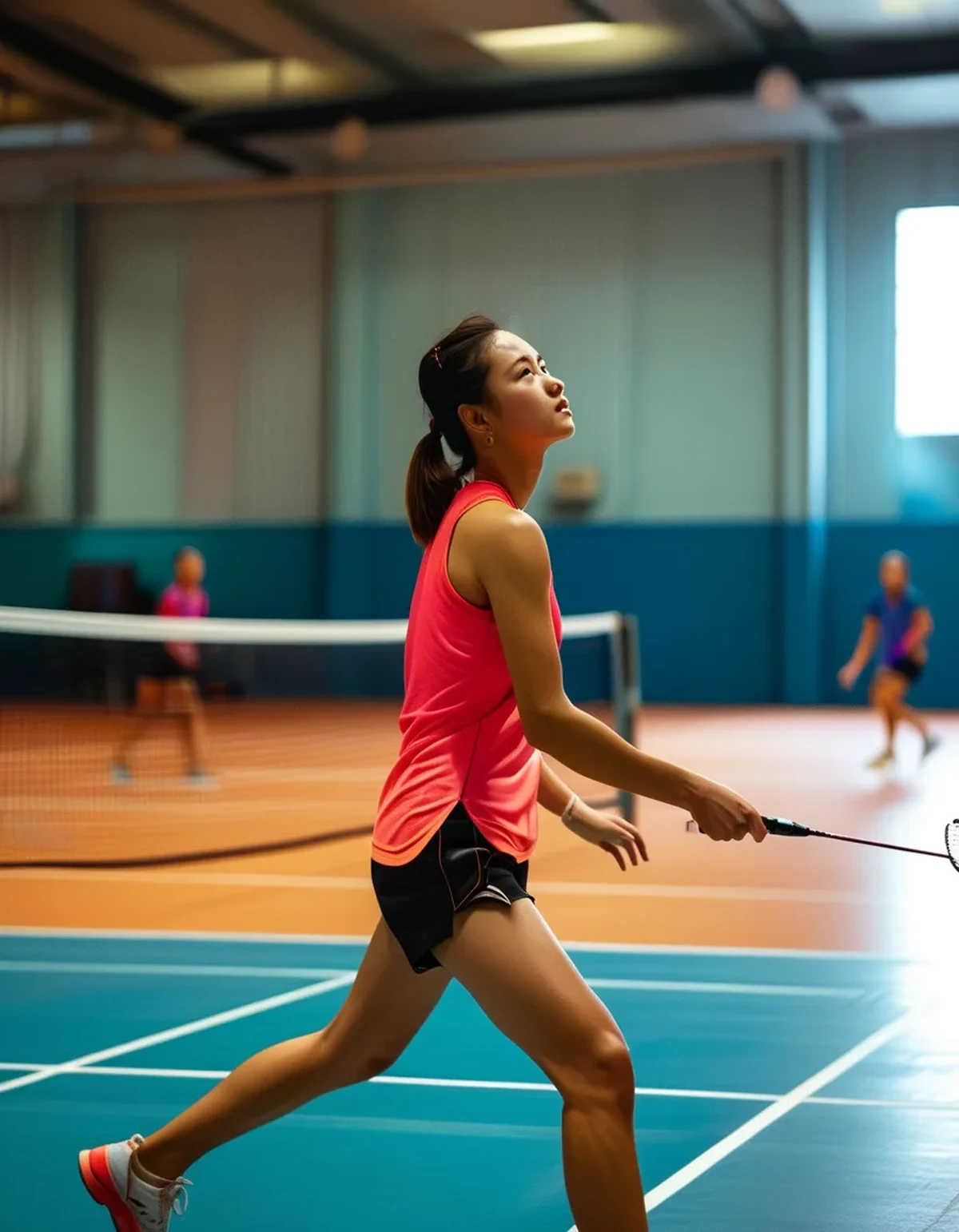
The most common single error: watching your own shot. Recovery should begin as the shuttle leaves your racket. Players who admire their drop shot are still stationary when the reply arrives, and no amount of footwork technique compensates for a late start.
Myth vs Fact: Badminton Footwork
Myth: Footwork is about speed. Fact: It is far more about anticipation and starting early. A player with an excellent split step and good court sense beats a faster player who starts late, consistently. Speed helps at the margins; timing decides most rallies.
Myth: You should always chassé because it is the correct technique. Fact: Chassé is one of three patterns and it is the right choice for short lateral movement. Using it to the rear corners is slower and is one of the clearest markers of an intermediate player.
Myth: Small quick steps are always better than long ones. Fact: Small steps are better for adjustment and recovery, long steps for covering distance. Using only small steps means many more ground contacts to reach the back corner, which takes longer and costs more energy.
Myth: Footwork drills need a court and a partner. Fact: Shadow footwork requires neither. Ten minutes of shadow work in any space with room to move produces real improvement in pattern quality, and it is how most serious players build their movement.
Myth: You should return to the exact centre after every shot. Fact: Your recovery position should shift based on where you hit the shuttle and what replies are likely. After a straight drop to the net, the optimal base position is slightly forward and to that side, not dead centre.
What does a useful footwork practice session look like?
Twenty minutes, twice a week, and it does not require a court.
Warm-up, 4 minutes. Light jogging, ankle circles, dynamic leg swings, and a few practice split steps.
Block 1 - shadow six corners, 6 minutes. From base, move to each of the six court positions and back, playing a shadow shot at each. Three sets of six corners, resting 45 seconds between sets.
The focus is pattern correctness, not speed. Chassé to the sides, cross step to the rear, lunge to the front. Slow and correct beats fast and sloppy at this stage.
Block 2 - split step timing, 4 minutes. With a partner miming a hit, or with a video of a player hitting. Land on their contact. Twenty repetitions.
Block 3 - recovery emphasis, 4 minutes. Same six corners, but the only thing you attend to is starting the recovery before the shadow shot finishes. This is the hardest habit to build and the most valuable.
Cool-down, 2 minutes. Calf and hip flexor stretches - both take a lot of load in badminton movement.
Film one set every few weeks. Footwork errors are almost invisible from inside and obvious on video. Most players discover they are chasséing to the back corners despite believing they had already fixed it.
FAQ: Badminton Footwork Questions, Answered
How long before footwork improvements show up in matches?
Shadow practice changes patterns within a few weeks, but transferring them into matches takes longer because match pressure defaults you to old habits. Expect roughly 6 to 10 weeks before it feels automatic under pressure.
Should I jump when hitting overhead shots?
A scissor jump is useful for rear-court overheads because it lets you hit earlier and higher and helps you recover forward. It is worth learning after your basic movement patterns are solid, not before.
Why do my calves hurt after badminton?
Badminton involves constant lunging, pushing off, and landing on the forefoot, which loads the calves heavily. Building calf strength with raises and progressing playing volume gradually both help. Persistent pain warrants a physiotherapist.
Are badminton shoes really necessary?
Yes, more than in most sports. They have flat non-marking soles for grip on indoor courts and lateral support for side-to-side movement. Running shoes have raised heels and are built for forward motion, which makes lateral movement less stable.
How do I stop getting caught flat-footed?
The split step, timed to your opponent’s contact. It is the single most effective answer to being caught stationary, and most players who feel slow simply are not doing it consistently.
TL;DR:
- Chassé for short lateral moves, cross step for the back corners, shuffle for small adjustments
- Chasséing to the rear corners is the most common intermediate error and costs real time
- The split step, landed exactly on your opponent’s contact, is the highest-return change available
- Start recovery as the shuttle leaves your racket, not after watching where it goes
- Twenty minutes of shadow footwork twice weekly, filmed occasionally, changes patterns within weeks
Most players who feel slow on court are not slow. They start late and use the wrong pattern for the distance, and both of those are fixable without getting any fitter.
Keep Reading
This article is for general informational and styling purposes only. Fit, sizing, and product availability may vary.