Badminton Racket String Tension Explained — and Why Yours Might Be Wrong
Quick Answer: Lower string tension (18-22 lbs) gives more power with less arm effort and suits beginners and intermediate players, while higher tension (24-28+ lbs) gives more control and precision but requires more swing speed to generate power — most recreational players are overstrung relative to their skill level and swing speed.
You’ve probably never thought about your racket’s string tension beyond restringing when a string snaps. But tension mismatched to your swing speed and skill level quietly costs you both power and comfort, game after game.

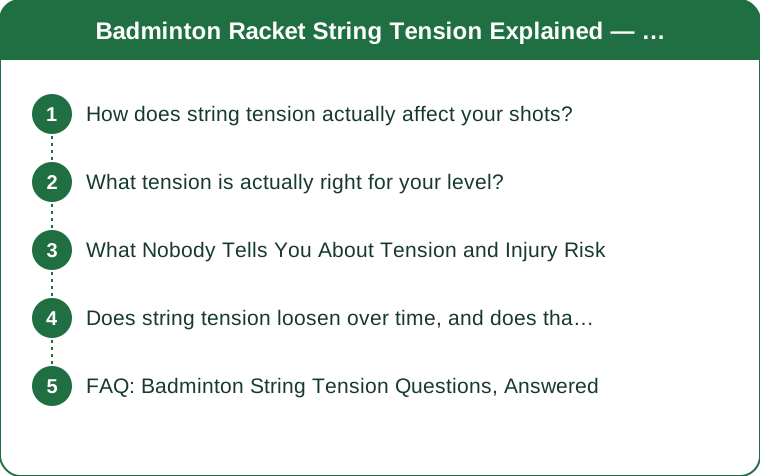
How does string tension actually affect your shots?
Lower tension strings act like a trampoline effect — the strings deform more on contact and spring the shuttle back with less swing effort required from you. Higher tension strings deform less, giving a more precise, controlled response but requiring more of your own swing speed to generate equivalent power.
This is why a beginner strung at high tension (mimicking a pro setup) often feels like they’re overworking every shot for underwhelming power.
What tension is actually right for your level?
Beginners and recreational players: 18-22 lbs generally gives more forgiving power without needing an advanced swing. Intermediate players developing more technique: 20-24 lbs balances power and control. Advanced/competitive players with fast, technical swings: 24-28+ lbs, since their swing speed already generates plenty of power and they need the added control.
Many recreational players are strung in the advanced range by default because shops assume higher tension equals better equipment — it doesn’t, if your swing speed doesn’t match it.

What Nobody Tells You About Tension and Injury Risk
Overstrung rackets for your swing speed force your arm and wrist to generate more power manually to compensate for the reduced trampoline effect — this added strain is an under-discussed contributor to tennis-elbow-like forearm pain in recreational badminton players, not just repetitive use alone.
If you’ve had persistent elbow or wrist soreness and haven’t considered your string tension as a factor, it’s worth checking against the ranges above before assuming it’s purely a technique or overuse issue.
Does string tension loosen over time, and does that matter?
Yes — strings naturally lose 10-15% of their tension within the first few weeks of regular play, and continue slowly loosening afterward. A racket strung at 24 lbs a few months ago may already be playing closer to 20 lbs, which is worth factoring in before assuming your current feel matches your original stringing choice.
FAQ: Badminton String Tension Questions, Answered
How often should I restring my racket?
For regular players, every 2-3 months or after noticeable loss of feel/power is reasonable; competitive players often restring more frequently.
Can I ask for different tension in the mains vs. crosses?
Yes — some players use slightly lower cross-string tension for extra power while keeping main strings higher for control; this is a common intermediate-to-advanced adjustment.
Is higher tension always ‘better’ equipment?
No — tension should match your swing speed and skill level, not represent a status upgrade. Overstrung rackets for your level often reduce performance and increase arm strain.
TL;DR:
- Lower tension (18-22 lbs) gives more power with less effort — good for beginners
- Higher tension (24-28+ lbs) gives control but needs faster swing speed to generate power
- Mismatched high tension can contribute to forearm and elbow strain over time
- Strings lose 10-15% tension within weeks of play — factor that into your feel
Matching tension to your actual swing speed, not your ambition, is the fastest free upgrade in badminton. This is general information, not medical advice.
Keep Reading
This article is for general informational and styling purposes only. Fit, sizing, and product availability may vary.