How to Choose Your Badminton Racket String Tension (Without Guessing)
Quick Answer: Lower tension (18-21 lbs) generally favors power and is more forgiving for beginners and intermediate players, while higher tension (24-28+ lbs) favors control and precision but requires more consistent technique to benefit from — matching tension to skill level and play style matters more than chasing what advanced players use.
String tension gets treated like a minor equipment detail, but it changes how forgiving or demanding a racket feels shot to shot — and stringing too high too early is a common mistake that makes progress harder, not faster.

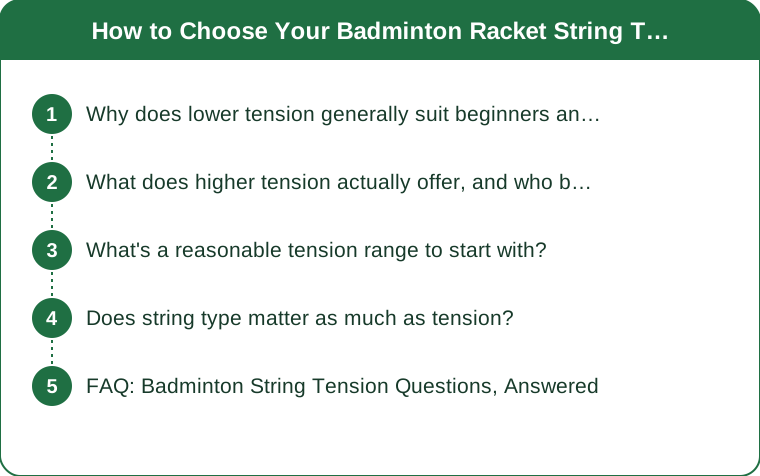
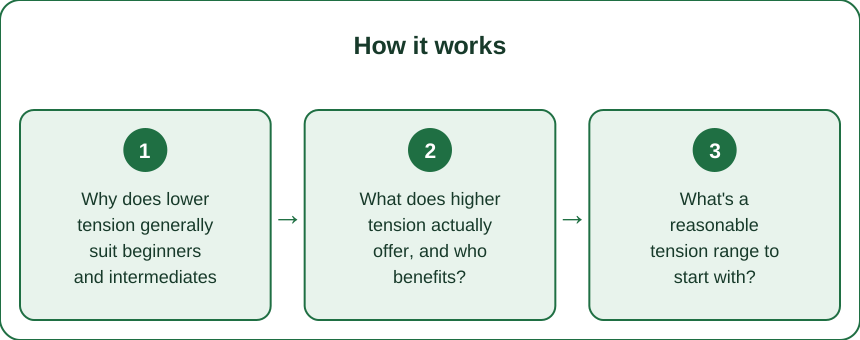
Why does lower tension generally suit beginners and intermediates better?
Lower tension strings deform more on contact, storing and releasing energy like a trampoline effect, which adds power with less precise timing required. This forgiveness matters most while technique and timing are still developing.
Higher tension strings deform less, requiring more precise contact to generate equivalent power — a demand that outpaces most developing players’ consistency.
What does higher tension actually offer, and who benefits?
More control and a more direct feel, since less string deformation means more predictable, precise shot placement for players with consistent, well-timed technique. This is why advanced and competitive players often string tighter — they can reliably access the control benefit without needing the power forgiveness.
Stringing high before your technique supports it usually just means less power and no meaningful control gain to show for it.

What’s a reasonable tension range to start with?
18-22 lbs is a common starting range for recreational and improving players, balancing power and reasonable control without demanding elite-level precision. Competitive players often move into the 24-28+ lb range as technique and consistency develop.
Adjusting in small increments (1-2 lbs) between restrings, rather than large jumps, makes it easier to actually feel what each change does.
Does string type matter as much as tension?
It’s a secondary factor — string gauge (thickness) and material affect durability and feel, but tension has a larger, more immediate effect on power and control than string type for most players. Get tension right first, then consider string type for durability or feel preferences.
Thinner strings generally offer more feel and spin potential but break faster, an important tradeoff for frequent players.
FAQ: Badminton String Tension Questions, Answered
How often should badminton racket strings be replaced or restrung?
A common guideline is restringing as many times per year as you play per week, though frequent players may restring more often as strings lose tension gradually even without breaking.
Can stringing too tight damage the racket frame?
Yes — stringing above a racket’s rated maximum tension increases frame stress and breakage risk; always check the manufacturer’s maximum rated tension before stringing high.
Should both singles and doubles players use the same tension approach?
Not necessarily — singles play often benefits from slightly more power-forgiving tension for covering the full court, while doubles’ faster net exchanges can favor the control of slightly higher tension, though individual technique still matters most.
TL;DR:
- Lower tension (18-22 lbs) favors power and forgiveness, better suited to beginners and intermediates
- Higher tension (24-28+ lbs) favors control but requires consistent technique to benefit
- Adjust in small 1-2 lb increments between restrings to actually feel the difference
- Get tension right first before prioritizing string type or gauge
The right tension isn’t the one advanced players use — it’s the one that matches where your technique actually is right now.
Keep Reading
This article is for general informational and styling purposes only. Fit, sizing, and product availability may vary.