The Jump Smash Landing Nobody Coaches - and Why Your Knees Notice First
Quick Answer: The jump smash is trained as a hitting action, but the landing is where the highest forces occur - typically on one leg, in a rotated position, while you’re already moving toward the next shot. Landing stiff-legged or across your body is what turns a good smash into knee soreness. The fix is training the landing as its own skill: soft knee and hip bend, both feet involved, and a scissor recovery that redirects force forward instead of absorbing it sideways.
Your smash has never felt better and your knees have never felt worse. Those two facts are related, and it isn’t the hitting.
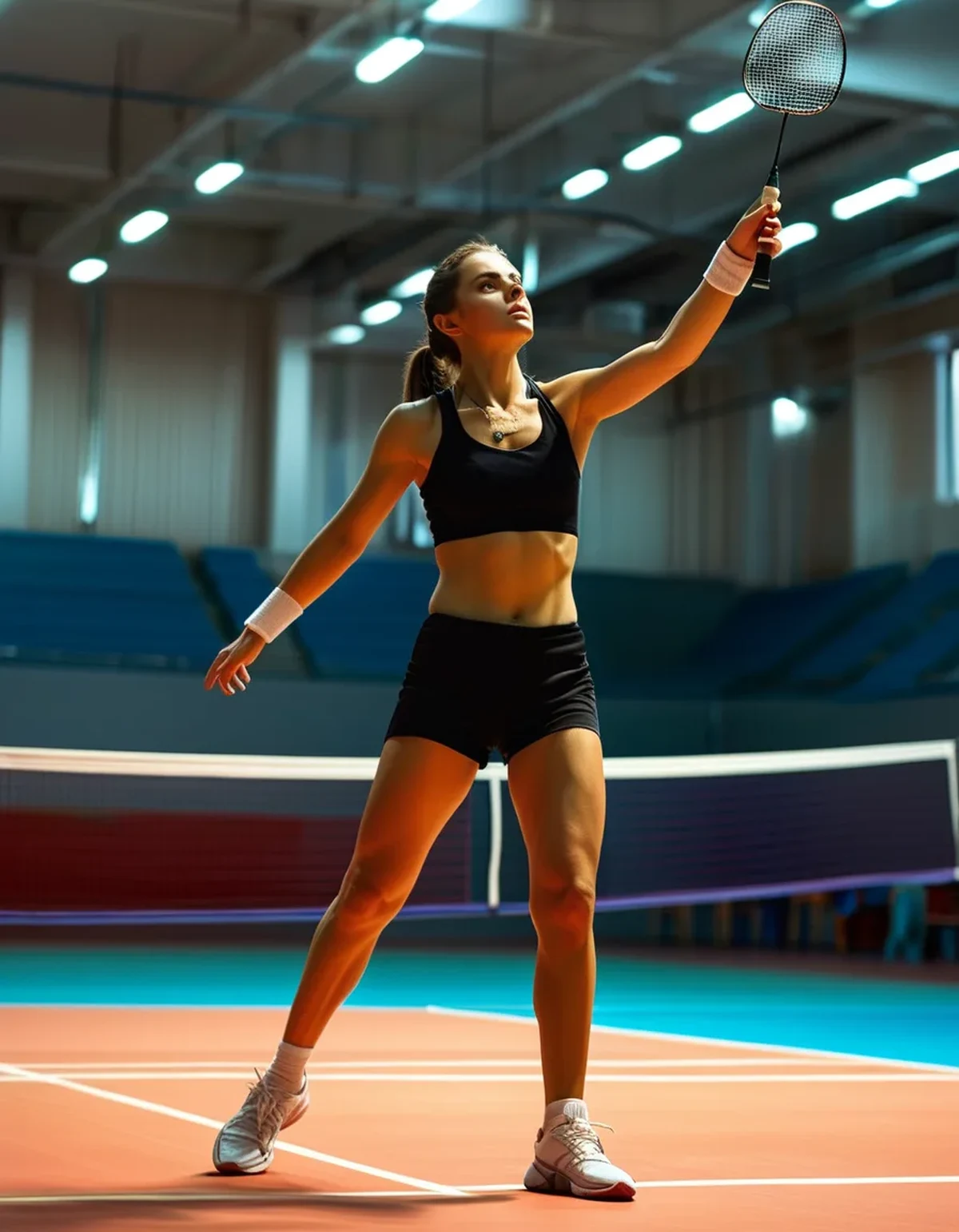
Why is the landing the risky part, not the jump?
Because jumping is a controlled push and landing is an uncontrolled catch.
Going up, you choose the force and your muscles shorten to produce it. Coming down, gravity chooses the force and your muscles have to lengthen under load to absorb it. Eccentric loading - muscle lengthening while resisting - is where most tissue stress and most delayed soreness originate, in any sport.
Badminton adds three complications that most jumping sports don’t:
- The landing is usually asymmetric. The scissor kick action means you come down on one leg first, frequently the racket-side leg, rotated.
- You can’t stop. In a rally you’re already loading the next movement before the landing has finished, so there’s no clean absorption phase.
- The court is unforgiving. Sprung wooden floors help; the sports-hall vinyl over concrete that many club players use does not.
The result is a single-leg, rotated, hurried eccentric landing repeated dozens of times a session. That’s a demanding pattern by any standard, and virtually nobody trains for it directly.
What does a bad landing actually look like?
Film yourself from the front at 60fps if your phone allows it, or just have someone watch these four things.
1. Knee travelling inward. The single most important thing to look at. If your knee collapses toward the midline as you land, force is going through the joint at an angle it isn’t built for. This is the finding most associated with knee complaints across sports.
2. Stiff, straight leg. A landing with minimal knee and hip bend transmits the shock straight up the chain. You want the joints doing the absorbing, not the bones.
3. Landing flat-footed with an audible slap. The forefoot should contact first with the ankle then yielding. A loud flat landing means the ankle skipped its share of the work.
4. Trunk still rotated on contact. If your chest is still facing sideways when your foot lands, the rotational force has to be absorbed by the knee, which is a hinge and dislikes rotation.
Quick self-test off court: step off a low box onto one leg and hold for three seconds. If you wobble noticeably, or your knee dives inward, or you can’t hold it, your landing mechanics under match speed are almost certainly worse than that.
What Nobody Tells You About Badminton Knee Load
The smash isn’t the highest-load shot for your knees - the deep backhand corner retrieval is. That lunge-and-return happens dozens of times a rally with a fully loaded, deeply flexed front knee. Players attribute soreness to the flashy shot and it usually came from the boring one.
Shoe cushioning is the wrong thing to shop for. Badminton shoes are deliberately low-profile because ankle stability and court feel matter more than cushioning, and a thick sole increases roll risk. Buy for grip, low stack height, and a fit that doesn’t slide - not for plush.
Court surface changes the load more than technique does. The same session on sprung wood versus vinyl-over-concrete is not the same session for your joints. If your home hall is hard, that’s an argument for fewer jump smashes in training, not for better landings alone.
Fatigue degrades landings before it degrades hitting. Your technique holds up in the last game; your landing mechanics don’t. This is why late-session and late-tournament sessions carry more risk than the first hour.
And single-leg strength predicts landing quality better than squat numbers. Plenty of players with a solid double-leg squat land badly, because badminton almost never asks for a symmetrical two-legged effort.

How do you train the landing itself?
Three exercises, twice a week, 15 minutes. Do them fresh, before you’re tired - you’re training a pattern, not conditioning.
1. Drop landings (weeks 1-3). Step off a 20-30cm box, land on both feet, absorb quietly, hold for two seconds. 3 sets of 6. The goal is silence - a quiet landing is a well-absorbed one. Progress to single-leg drops from a lower box.
2. Scissor jump landings (weeks 2-6). Jump on the spot with the badminton scissor action, land in your normal split, then immediately step forward into a recovery step. 3 sets of 6 per side. This trains the landing plus the redirection you actually need in a rally.
3. Single-leg RDLs and split squats (throughout). Slow, controlled, 3 seconds down. 3 sets of 8 per side. This is the strength base that lets the first two look good, and it’s the one people skip.
On-court adjustments that help immediately:
- Take the scissor landing on both feet when the shuttle allows. Not every overhead needs the full jump smash - a controlled two-footed landing off a lower jump costs you very little power.
- Land and step, don’t land and stop. Redirecting into a recovery step distributes force over time instead of dumping it into one leg.
- Cap jump smashes in practice. They’re a small fraction of match points and a large fraction of joint load.
When is knee pain a stop-training signal?
Most badminton knee soreness is load-related and settles with adjustment. Some doesn’t, and the distinction matters.
Generally manageable: dull ache around or below the kneecap that appears after sessions, improves with a day or two of easier training, and doesn’t get worse within a session.
Worth a professional opinion: pain that sharpens rather than fades as you warm up, swelling, a knee that gives way, locking or catching, or pain that has been present for more than a few weeks despite reducing load.
Practical load management that works: reduce total jumping volume rather than total training - keep the footwork, the drives, the net play, and cut the jump smash count for two to three weeks while you build the strength base. Cutting everything usually means detraining, which makes the return worse.
And address the boring inputs: sleep, protein, and how many sessions a week you’ve quietly added since the season started. Load that increases faster than about 10% a week is the most common cause of the thing people blame on technique. This is general information, not medical advice - persistent joint pain deserves an actual assessment.
FAQ: Badminton Landing Questions, Answered
Should I stop jump smashing entirely if my knees hurt?
Usually no - reduce the count rather than eliminating it, and train the landing pattern separately. Complete avoidance means you’re less prepared when you inevitably jump in a match.
Do knee sleeves help?
Many players report they help with comfort and proprioception, which is worth something. They don’t change landing mechanics, so treat them as a comfort measure alongside the strength work rather than instead of it.
How long before better landings feel automatic?
Deliberate practice shows in about 3-4 weeks; automatic under match pressure typically takes a full season of consistent work, because match speed is where old patterns resurface.
Is a two-footed landing always safer?
Generally it distributes load better, but it’s slower to recover from in a fast rally. The realistic answer is to use it when the shuttle gives you time and to train the single-leg version for when it doesn’t.
TL;DR:
- Landing, not jumping, produces the highest and least-controlled forces in badminton
- Watch for knee-inward collapse, stiff legs, flat loud landings, and a still-rotated trunk
- The deep backhand corner lunge loads knees more than the smash people blame
- Train drop landings, scissor landings, and single-leg strength twice a week, fresh
- Cap jump smash volume in practice and increase total load by no more than ~10% a week
Everyone films their smash. Film your landing once and you’ll spend the next month fixing something more useful.
Keep Reading
This article is for general informational and styling purposes only. Fit, sizing, and product availability may vary.