Why Your Clears Keep Falling Short of the Back Line
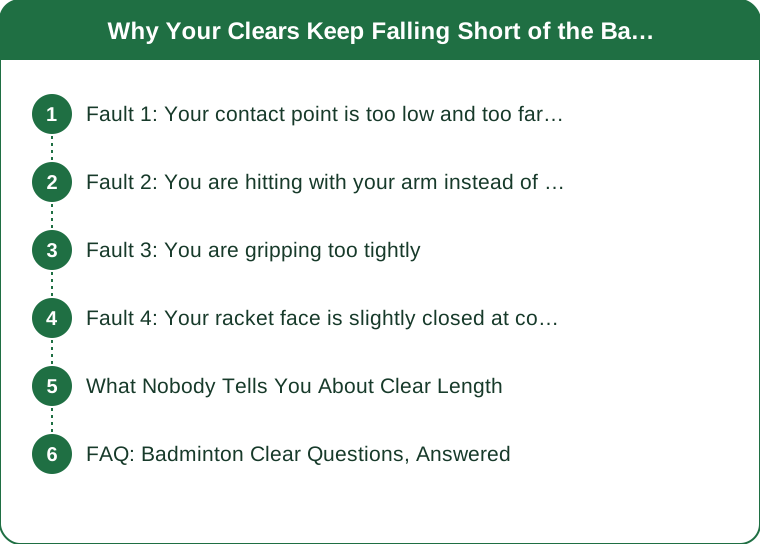
Quick Answer: Short clears are usually caused by contacting the shuttle too far in front or too low, hitting with the arm instead of rotating through the body, gripping too tightly through the swing, or the racket face being slightly closed at contact. Fix the contact point first - most players are hitting a foot too low and well in front of the ideal position, and correcting that alone adds significant length.
Everyone who plays for a while gets told to use more wrist. It is one of the least helpful pieces of coaching advice in the sport.
Fault 1: Your contact point is too low and too far forward
This is the biggest one by a wide margin, and it is invisible from the inside.
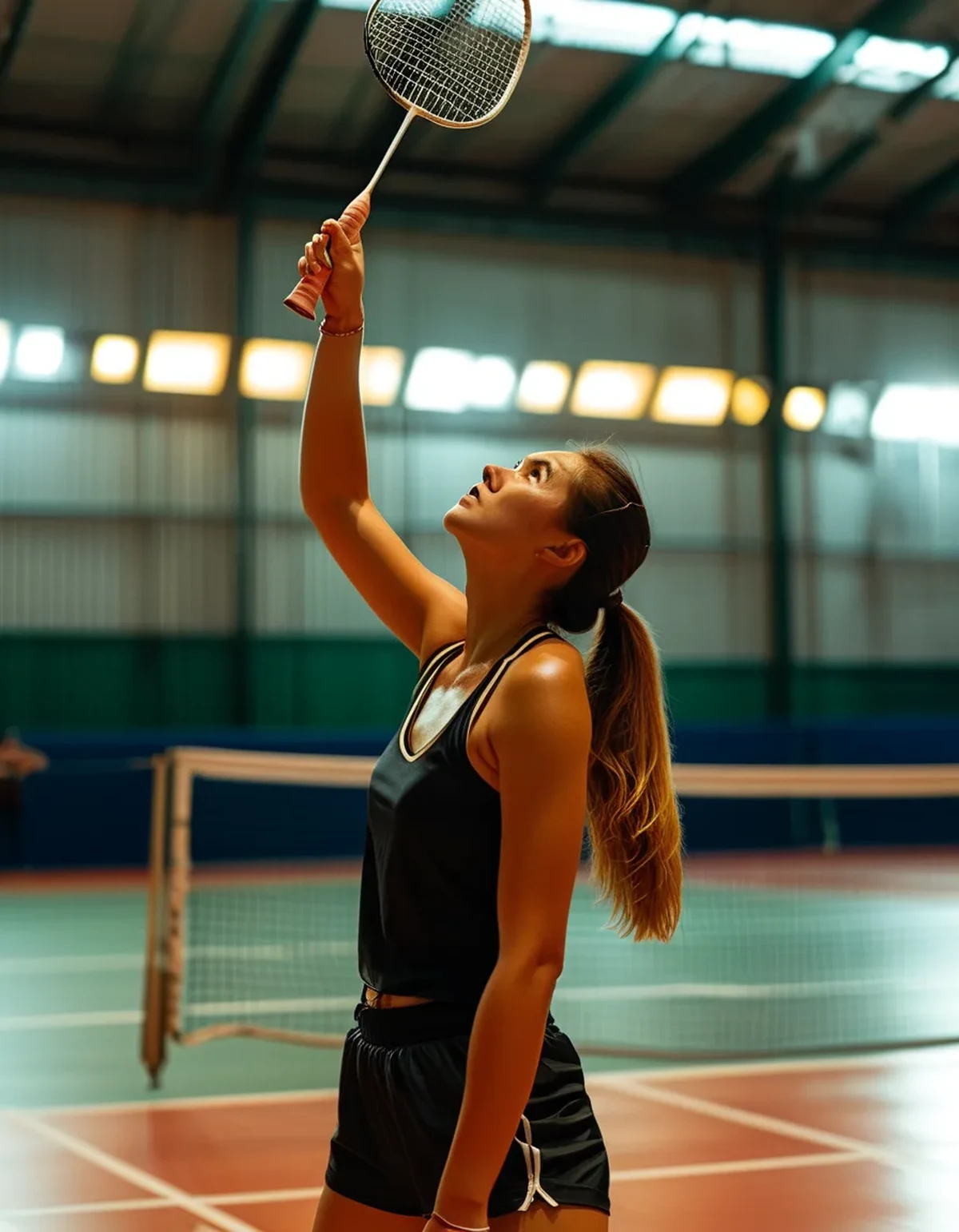
The ideal contact for a clear is high, slightly in front of your racket shoulder, with the arm nearly fully extended. Most recreational players contact the shuttle noticeably lower and considerably further in front - somewhere ahead of the head rather than above and slightly ahead of the shoulder.
Why it costs so much length: contacting low means the shuttle needs a much steeper upward angle to clear the net and travel deep, and steeper angles trade distance for height. Contacting too far forward means the racket has already passed the fastest point of its arc and is decelerating at impact.
How to check: film yourself from the side for one rally. Freeze at contact. Is your arm extended? Is the shuttle above your shoulder line?
The fix is footwork, not arm position. Contacting low almost always means you arrived late and reached rather than getting under the shuttle. Move earlier, take the last step into position rather than toward the shuttle, and the contact point corrects itself. Practise shadow movement to the rear corners with no shuttle to build the arrival speed.
Fault 2: You are hitting with your arm instead of your body
Power in an overhead comes from a chain, and the arm is the last and smallest link.
The sequence runs: legs push from the ground, hips rotate, torso rotates, shoulder comes through, elbow extends, forearm rotates, and finally the hand. Each segment adds speed to the one after it. A player using only the arm is starting the chain three links from the end.
Signs you are arming it:
- Your feet stay flat and your hips stay square to the net through the shot
- Your shoulders finish the shot in the same orientation they started
- You feel it in your shoulder rather than through your whole side
- You can hit almost as far standing still as you can from a proper position
The fix: practise the rotation without a shuttle. Stand side-on with the non-racket shoulder pointing at the net, feet apart. Push off the back foot, rotate the hips, then the shoulders, and let the arm follow. The racket should feel like it is being whipped through by the body, not driven by the shoulder.
Adding a scissor kick - the back foot swapping forward as you strike - is what links the ground force into the rotation, and it is the single technical addition that most improves clear length.
Fault 3: You are gripping too tightly
Counterintuitive, and one of the most effective single changes available.
A badminton racket generates most of its speed in the final fraction of a second, through forearm rotation and a rapid tightening of the grip at contact. If you hold the grip tightly throughout the swing, that final acceleration cannot happen - there is nothing left to tighten.
How it should feel: relaxed grip through the preparation and the swing, then a sharp squeeze at the moment of contact, then relaxed again. Coaches often describe this as the grip only existing for one instant.
Why players grip hard: usually tension from trying to hit harder, which produces exactly the opposite result. It is also common when the racket feels too heavy or the grip is too small.
A test: hit ten clears deliberately at about 70 percent effort with a consciously loose grip. Most players find these travel further than their maximum-effort attempts. If that is true for you, tension is your limiter, not strength.
Check your grip size too. A grip that is too thin encourages over-squeezing; one slightly thicker often relaxes the hand naturally. Adding an overgrip is a cheap experiment.

Fault 4: Your racket face is slightly closed at contact
A small angle error at contact makes a large difference at the back of the court.
For a clear you want the racket face to meet the shuttle with a slightly open or square face, sending it upward and deep. Many players, especially those who also play smashes, arrive with the face angled slightly downward - which is correct for a smash and wrong for a clear.
What it looks like in the result: the shuttle travels fast but flat and drops around the service line rather than the back line. If your clears are fast but short, this is almost certainly the fault - fast and short means you produced power and pointed it in the wrong direction.
The fix is the contact point again, which is why the first fault matters so much. Contacting slightly behind and above the shoulder naturally opens the face. Contacting well in front closes it.
A useful drill: practise hitting clears deliberately high and slow, aiming to land on the back line with maximum height. This forces an open face and a proper upward trajectory. Once the length is reliable, gradually flatten the trajectory back toward a normal attacking clear.
Also check the shuttle itself. Feather shuttles vary in speed grade, and a slow-grade shuttle in a cold hall genuinely will not reach the back line for anyone. Rule out the equipment before rebuilding your technique.
What Nobody Tells You About Clear Length
Strength is rarely the limiter. Junior players considerably lighter and weaker than most recreational adults hit full-court clears comfortably, because their technique sequences properly. If a 13-year-old can do it and you cannot, the missing element is not muscle.
Hall conditions change length substantially. Temperature, humidity, and air conditioning all affect shuttle flight, and a hall on a humid late-summer evening plays noticeably slower. Adjusting shuttle speed grade to the venue is standard practice for a reason.
Fatigue shows up in the contact point first. Late in a match, footwork slows, you arrive lower, and clears shorten. That is a fitness problem presenting as a technique problem, and the fix is movement conditioning rather than more clear practice.
Your non-racket arm matters more than you think. Pointing it at the shuttle helps you track it, sets the shoulder rotation, and pulls down as the racket comes through, which adds to the rotation. Players who let it hang lose rotational speed.
And the one that helps immediately: hitting at 80 percent effort with clean technique produces longer clears than 100 percent with tension. Maximum effort is where technique breaks down, so most players’ best clears are not their hardest ones.
FAQ: Badminton Clear Questions, Answered
Should I use more wrist?
The common advice to use your wrist is misleading. The relevant action is forearm rotation - pronation - rather than the wrist flexing. Focusing on flexing the wrist tends to produce a weaker shot and can irritate the joint.
Will a different racket give me more length?
A head-heavy racket can add power for the same technique, and a racket that is too heavy for you will reduce swing speed. Neither compensates for a contact point that is too low. Fix technique first, then consider equipment.
Why are my backhand clears so much shorter?
The backhand has less available rotation and a shorter chain, so it is harder for everyone. Technique matters even more here - contact point and forearm rotation account for almost all of the difference between players.
How long should it take to fix?
Contact point and grip pressure often improve within a few sessions. Full body rotation, especially with a scissor kick, typically takes several weeks to become automatic under match pressure.
Is shoulder pain when clearing normal?
No. Persistent shoulder pain during overheads usually indicates a technique issue loading the joint rather than the chain, or a volume problem. Worth having assessed rather than training through. This is general information, not medical advice.
TL;DR:
- Contact point is the biggest factor - high, above and slightly ahead of the racket shoulder, arm extended
- Power comes from ground, hips, torso, then arm; arming the shot skips most of the chain
- Relax the grip through the swing and squeeze only at contact
- Fast but short clears mean a closed racket face - the fix is the contact point again
- Check the shuttle speed grade and hall conditions before rebuilding your technique
The reason short clears feel like a strength problem is that trying harder is the intuitive response, and trying harder makes every one of these four faults worse. Move earlier, get under the shuttle, rotate through it, and stay loose - and your clears get longer at lower effort. This is general information, not medical advice.
Keep Reading
This article is for general informational and styling purposes only. Fit, sizing, and product availability may vary.